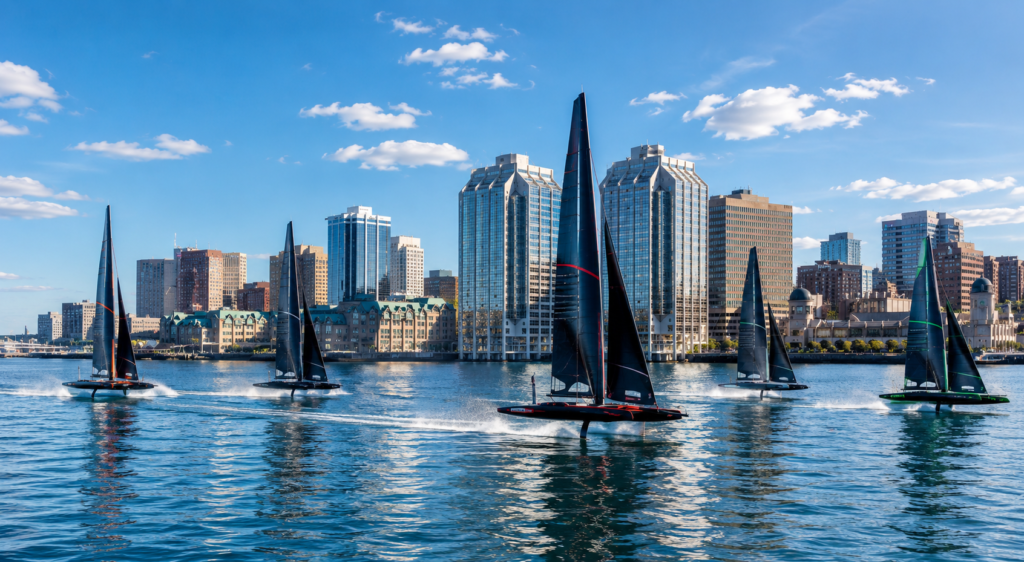
Featured image generated with AI for illustrative purposes
By Roddy Carlo Founder & Editor, FrancoDeal Magazine
There are stops a calendar simply passes through, and others that compel the championship to rewrite its own rules. Halifax now belongs to the second category.
Held on 20 and 21 June 2026 on Halifax Harbour, the Canada Sail Grand Prix did more than confirm the photogenic pull of Nova Scotia’s waterfront: it led SailGP to adopt an unprecedented format tailored to the harbour itself. When a place imposes its will on the most technological of sailing championships, it has become a character in its own right.
A Format Born of the Water
The novelty of this edition was no footnote: for the first time in its history, SailGP split its thirteen-boat fleet into two distinct groups for the weekend. On one side, Australia, France, Spain, Denmark, New Zealand, Canada and Brazil; on the other, Great Britain, the United States, Switzerland, Germany, Italy and the Swedish Artemis.
Each team scored points only within its own group, with the top two from each advancing to a final widened to four boats — where the championship normally settles for a three-boat showdown.
The choice stems from Halifax’s very geography: a tight, demanding basin where the density of the full fleet would have undermined the legibility of the racing. Rather than endure the setting, SailGP embraced it. This is the opposite of the usual logic of major sporting formats, which bend venues to their own template.
Here, the place wrote the rulebook.
Patience, Then Spectacle
Saturday disappointed at first. A rain cell swept across the harbour just before the start, taking the wind with it and leaving the F50s pinned flat on foils designed for far stronger conditions.
The opening Group A race was even abandoned: the Bonds Flying Roos of Australia had crossed the line in front, but a few seconds past the regulation time limit. The day felt long, demanding patience from competitors and spectators alike.
Sunday turned everything around.
With the wind finally present, the bay became a theatre. More committed conditions, twists, overtakes and a four-boat final fought to the very last legs: Halifax delivered exactly the drama the previous day had withheld.
It is precisely this contrast — patience, then explosion — that gives a stage its narrative value. A great backdrop does not guarantee the spectacle; it amplifies its power when it comes.
The Verdict: Spain Prevails
At the close of that finish, it was Spain’s Los Gallos, helmed by Diego Botín, who claimed victory — their first event win of the 2026 season — in a fiercely contested four-boat final.
A result made all the more striking by the fact that it came against an Australian Bonds Flying Roos crew that had dominated the first half of the championship.
For the French colours, the edition ended in fourth place for Quentin Delapierre’s DS Automobiles SailGP Team, marked by the notable return of strategist Manon Audinet after several months of recovery.
Halifax thus confirms its reputation as a selective body of water: a course capable of producing clear hierarchies while still leaving the door open to reversals.
The Harbour as a Stage
SailGP understood, ahead of many other disciplines, that sporting performance alone was no longer enough.
F50s launched at spectacular speeds, short formats, production designed for global broadcast: the championship is as much a media object as a sporting one.
But not every harbour produces the same quality of image.
Halifax enjoys a rare advantage: its geography makes the racing immediately legible to the eye, while offering a depth of setting that reaches far beyond the competition itself.
When the F50s surge at full speed in front of the waterfront, the line between sport and spectacle becomes almost imperceptible. The boats seem to fly above the water, set against one of the most iconic natural harbours in North America.
The port, the grandstands, the historic quays and the immediate proximity between city and sea compose a spectator experience that is legible, premium and instantly shareable.
Where other sporting events line up sequences of performance, Halifax tells something larger: a city turned toward the sea, a crowd in direct contact with the action, and a shoreline able to carry an aesthetic of prestige without excessive artifice.
A Destination That Shapes the Story
For FrancoDeal Magazine, the lesson of Halifax reaches far beyond the standings.
A maritime destination did far more here than host a major sporting event: it set its own tempo, to the point of shaping the very format of the competition. This is the mark of true destinations of distinction — not the backdrops that fade behind the event, but those that carry it.
At a time when territories compete for attention in an ever-fiercer global contest, Halifax shows that a destination needs no artifice to leave its mark. It needs only an identity strong enough to become indispensable to the story the event tells.
This is where great destinations separate themselves from beautiful ones: not by hosting the story, but by becoming part of it.
On Location in Halifax
The following photos and videos were captured by Roddy Carlo while exploring Halifax Harbour shortly after the Canada Sail Grand Prix. They provide additional perspective on the waterfront environment that inspired this article and helped shape one of the most distinctive stops on the SailGP calendar.
Halifax Waterfront
Exploring Halifax Harbour shortly after the Canada Sail Grand Prix.
Video by Roddy Carlo for FrancoDeal Magazine.
About the Author
Roddy Carlo is the founder of the FrancoDeal ecosystem, including FrancoDeal Magazine, FrancoDeal Collections and FrancoDeal AI Studio. Through a multilingual editorial approach, he covers destinations, hospitality, maritime culture and premium travel experiences for an international audience.


